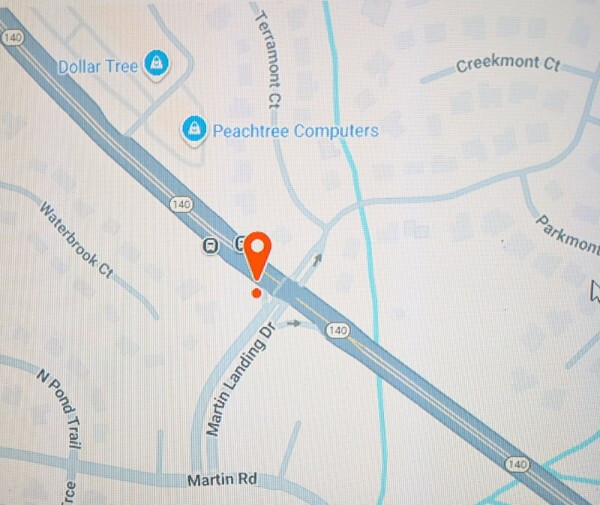
Title: Entrance to Martin’s Landing
Description: Entrance sign welcoming residents and guests to the Martin’s Landing subdivision.
Supplemental Information: Brass sign depicting a view of Martin Lake with geese flying overhead. The sign is adorned with flowers all year long, decorated for holidays, and lit at night. The sign is next to, and beautifies a public transportation bus stop.
The email says “the community has decided not to accept your Wayspot nomination.”
The rejection reason is: “The submission is likely not permanent or distinct”
The sign is made of metal and stone, how is that not “permanent?”
As for “distinct” Martin’s Landing is named for a historic ferry crossing over the Chattahoochee River, pre-civial war. Once the Chattahoochee was damned to create the Lake Lanier Reservoir in the 1950’s the land where the Martin’s Landing Subdivision stands became available. At the center of the subdivision is a large 53 acre lake (Martin Lake) which is depicted in brass on the sign in the submission. It doesn’t get more “distinct” than that.
There are three entrances to the subdivision, but only the main entrance has the sign in the submission.
Can someone please explain why the “community” would reject this POI?
Thank you for your careful consideration.
The rejection would have been for not being “distinct,” as in not being something that truly embodies any of the core criteria of a great place for exercise, exploration, or being social.
I will let others comment on whether an appeal of this one might fare better. It does have a better case to be made with the art display.
You should have provided the info about this neighborhood being named after a historic ferry crossing, as I’d imagine most reviewers don’t know that it’s related to something historic.
As for the art aspect, I don’t find this any different than other metal neighborhood signs made from metal, so I wouldn’t see this as a distinct piece of art. There are many that are very similar to this across the US.
If you do appeal, you may want to go the route of the historic crossing. In other parts of the world, there are historic neighborhood signs that have been accepted, so the history angle might be the better way to go.
This is not rejected because its not permanent but because its considered not distinct (by reviewer) - both rejection is under same clause.
Did you mention all these in supporting information? The onus is on submitter to present enough evidence to convince reviewer. If you have done so, please get more evidence about it.
Subdivision signs are not valid Points of Interest (POIs) in Pokémon GO. They are inherently generic, lack cultural or historical significance, and do not meet the standards of what makes a location meaningful or engaging for players. Nearly every residential neighborhood has one — they serve a functional purpose, not an exploratory one.
The core philosophy of Pokémon GO is built around exploration, discovery, and movement. POIs should encourage players to get out, walk, and interact with the world around them — not spin stops from their front porch. Approving subdivision signs as POIs undermines that mission and dilutes the quality of the game map.
We should be nominating locations that reflect the uniqueness of a community — parks, public art, historical markers, and gathering places — not defaulting to repetitive residential signage. That’s not what the game was designed for, and it’s not what keeps players engaged.
Just a clarification: PoGo could add anything as stops/gyms, but Wayfarer, the database map, has eligibility criteria, so there are things that may or may not be eligible. For example. PoGo has sponsored stops/gyms with different businesses, but these are not a part of the Wayfarer map currently.
So, we are building the Wayfarer map, which is used by all Niantic Scopely games, not just PoGo.